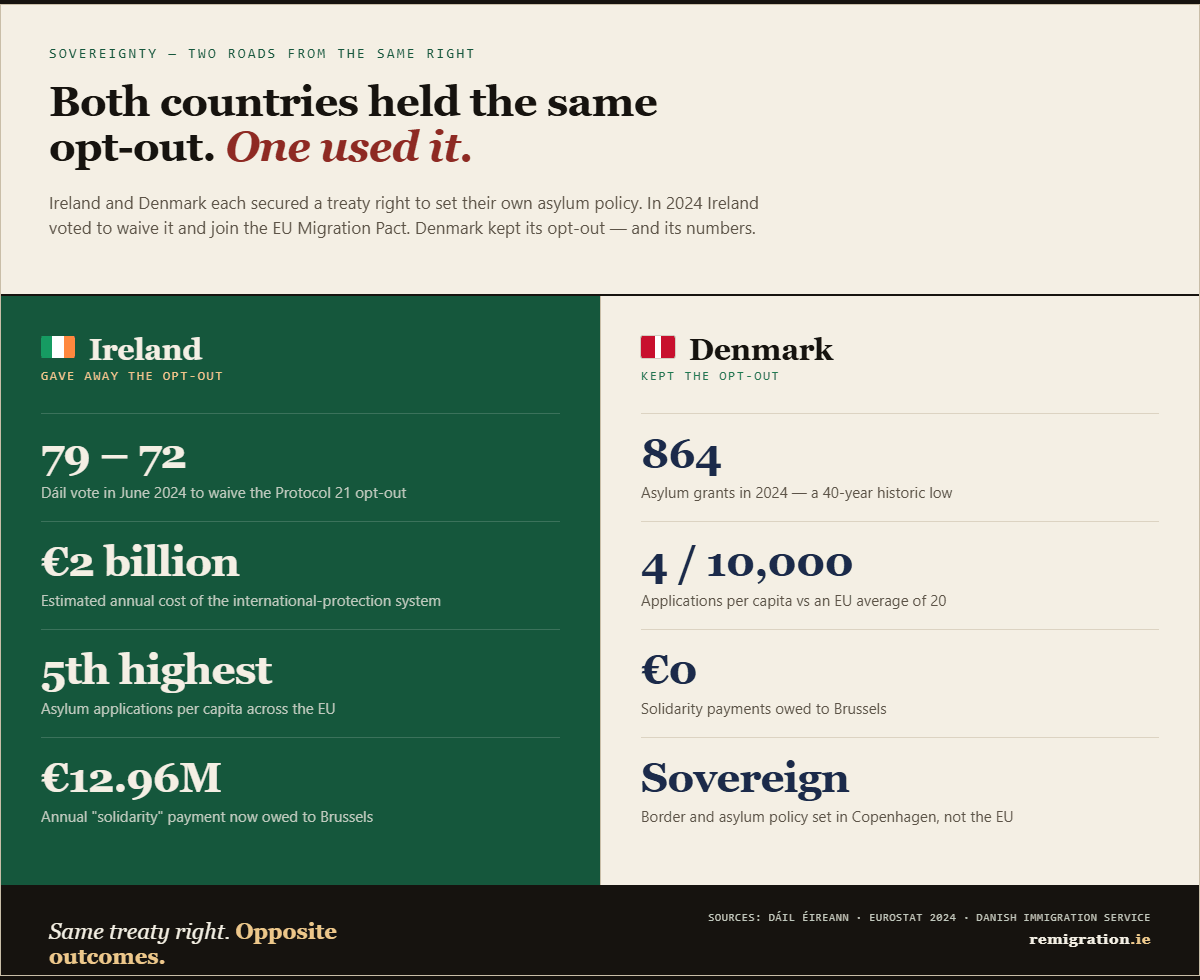
Denmark holds an EU opt-out on justice and asylum much like Ireland’s Protocol 21. Faced with the same legal freedom, the two countries went in opposite directions. Denmark used it to build one of the most restrictive asylum regimes in Europe — and granted just 864 asylum applications in 2024, its lowest figure in 40 years. This pillar is the side-by-side: what Denmark did, what the numbers are, and the fair objections to copying it.
The claim
The case for the Denmark model is that a wealthy European social democracy — not a hard-right outlier — has shown that asylum numbers are a policy choice, not a force of nature. Denmark’s governing centre-left Social Democrats built the regime: a “zero asylum seekers” aspiration, temporary rather than permanent protection, paused integration, and a credible message that arrivals will not lead to settlement. Supporters argue the result — claims running at a fifth of the EU average — proves deterrence works and protects social cohesion and the welfare state.
The counter-claim, stated fairly
Critics make three serious points. First, parts of the Danish approach have drawn criticism from UN bodies and human-rights organisations — particularly temporary-protection rules that have pushed some recognised refugees toward return to countries others consider unsafe. Second, Denmark sits outside the EU asylum acquis in ways Ireland, having now opted into the Pact, does not — so a straight copy is not legally available without unwinding commitments first. Third, deterrence figures are contested: arrivals are shaped by geography and pull factors elsewhere, not by one country’s rules alone. A fair debate kit carries these objections, not just the headline number.
Why it matters for Ireland
The Denmark comparison is the strongest single argument in the sovereignty debate, because it removes the “we had no choice” defence. Two states, two near-identical opt-outs, two opposite outcomes. The detailed legal and comparative analysis is in the Denmark Model brief and the Protocol 21 brief; the political story of Ireland’s choice is in the sovereignty record.
Use these facts
- The Denmark Model brief — the full comparative analysis, sourced to Danish and EU data.
- The EU Migration Pact — the road Ireland chose instead.
- Austria’s remigration ministry — another European government moving in the restrictive direction.
Get the weekly briefing
New facts, fresh data, what’s actually moving in Irish and European migration policy. Mondays, in your inbox.